November 11, 2026
In September 2025, top government censorship officials from Europe, the UK, Brazil, California, and Australia met at Stanford to discuss ways to coordinate censorship at an international level. The meeting was titled “Compliance and Enforcement in a Rapidly Evolving Landscape.” Australia’s top censor, eSafety Commissioner Julie Inman Grant, gave the keynote.
Though Grant did not provide her remarks to Public, previously she had told the World Economic Forum (WEF) that she was organizing censorship officials around the world because “we know we’re going to go much further when we work together with other like-minded independent statutory authorities around the globe.”
Inman Grant’s efforts appear to be coming to fruition in Australia, where the lower house has passed sweeping censorship and surveillance legislation that the Senate is now considering. The legislation would allow the Commissioner to monitor “lawful but harmful” speech.
Inman Grant, an American who once volunteered to a journalist that she turned down a job with the CIA, can already order a platform to reveal who is behind an anonymous account from anywhere in the world.
But the DDoC bill now before the Australian Senate would also let her use fake accounts that deceive users into thinking they are citizens and not government spies, record their legal speech, and give what she learns directly to Australia’s spy agencies. Those agencies could then share that intelligence with the FBI and other “Five Eyes” intelligence-sharing partners in the US, UK, Canada, and New Zealand.
The bill enables this by granting eSafety the ability to create an unlimited number of AI-generated “sock puppet” identities (effectively bots) under policies set “in consultation with the Commissioner of the Australian Federal Police.”
The private information that the Australian government could share with foreign intelligence agencies could include a user’s name, address, phone number, email, along with what the Privacy Act calls “sensitive information,” which includes political opinions, religious beliefs, sexual orientation, and health records.
The Institute for Public Affairs (IPA) first reported on the Privacy Act changes on Monday, and Network Affects noted last month that the new censorship legislation designates eSafety an “enforcement body” under the Privacy Act, expanding its ability to access personal information.
In 2013, documents released by whistleblower Edward Snowden revealed that British intelligence officials had allowed, as part of a secret deal with the U.S. government’s National Security Agency (NSA), for it to gather information on UK citizens who were not under suspicion of any wrongdoing.
The eSafety Commissioner could thus unmask anonymous accounts in the United States, France, or Germany, for example, that complain about controversial issues like mass migration, and report them and all of their private information to the FBI and European spy agencies.
“We have power to share with the AFP [Australian Federal Police]; we don’t have power to share with intelligence agencies at this time,” testified Heidi Snell, eSafety’s General Manager of Regulatory Operations, in October this year. “But the amendments would see us being able to share directly with those other government agencies,” she added.
Those agencies include the Australian Secret Intelligence Service (ASIS), Australia’s equivalent of the CIA; the Australian Security Intelligence Organisation (ASIO), which performs a role similar to the FBI’s domestic intelligence division; the Australian Signals Directorate (Australia’s NSA); the Office of National Intelligence (ODNI); the Department of Home Affairs (DHS); the Department of Foreign Affairs and Trade (State Department); the Department of Defence; and any other “Commonwealth entity.”
The DDoC Bill contains a provision that would put eSafety in the same legal category as the Australian Federal Police under the Privacy Act for “surveillance activities, intelligence gathering activities or monitoring activities.”
eSafety told Public in an email that information it sends to the police may include “the account names or the identity of the users who posted the material.” A Federal Police witness testified on Oct 21 that police can pass eSafety’s information to “our ASIO partners.”
The censorship bill would change Australia’s Privacy Act so eSafety could collect sensitive personal information, including political opinions, without users’ consent,a warrant or judicial oversight. To invoke this Privacy Act exception, it would only need to “reasonably believe” that the collection is necessary for its functions.
For a regulator whose mandate is about to expand to preventing online harm, it’s difficult to imagine a limit to the scope of these new information-gathering powers.
Investigative journalists have long suspected Five Eyes agencies of spying on each other’s citizens to get around domestic limits. In 2013, a Canadian federal judge found that Canada’s spy agency had secretly asked foreign intelligence partners to intercept Canadians’ communications abroad without legal authority.
Countering Populism
In May of this year, the Minister of Home Affairs, the equivalent to the DHS in the US, Tony Burke, announced A$74 million over two years for a new Counter Terrorism Online Centre, jointly led by ASIO and the AFP. The centre is tasked with monitoring “high-risk” online spaces and conducting “covert online engagement.”
At a press conference announcing the Online Centre, Burke warned of Australians being “radicalised online, being radicalised fast, having mixed ideology and not necessarily the traditional ideologies that might be attached to terrorism.”
When asked whether more regulation of gaming platforms was needed, Burke said the powers were “not held by me” and that it is something “the eSafety Commissioner provides us advice on.”
eSafety told Public that it “has met with the Counter Terrorism Coordinator and will continue to engage with the Counter Terrorism Online Centre.” It also confirmed a July privacy assessment for intelligence-gathering tools that “have not yet been procured,” but refused to make it public.
In 2023, the Albanese government quadrupled eSafety’s annual base funding, from A$10.3 million to A$42.5 million. As part of a broader Home Affairs funding package, the government committed a further A$6.7 million over four years for “additional resources to receive and respond to referrals of abhorrent content, especially out of hours.” Another A$3.5 million was allocated to Home Affairs to expand domestic online monitoring and referrals.
The investments show a growing relationship between the two agencies under Albanese. A February 2024internal Home Affairs briefing released under FOI reveals that its Countering Violent Extremism (CVE) division was “working closely with eSafety” on the A$3.5 million initiative.
An eSafety spokesperson told Public that the A$6.7 million funded resources to handle reports and referrals and upgrades to an existing case management system used to process information received through its online reporting portal. But the agency denied receiving any of the separate A$3.5 million allocated for domestic online monitoring and referrals, or undertaking activities under that initiative.
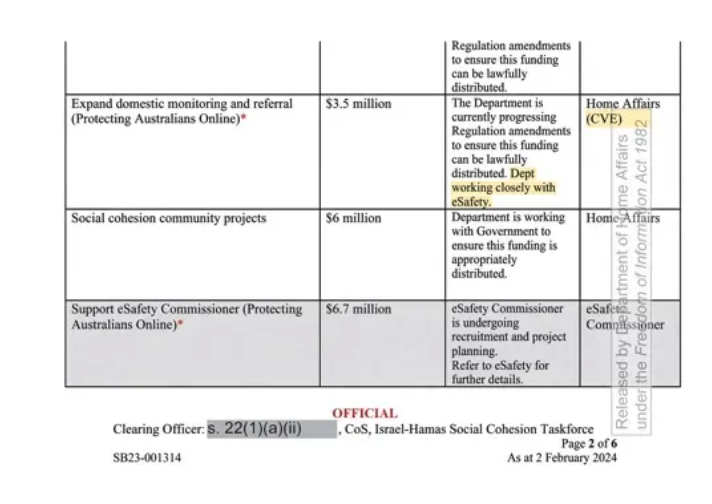
Public has been asking Home Affairs since last week to explain how the A$3.5 million was spent, what its cooperation with eSafety involved, and whether information collected by eSafety feeds into its Countering Violent Extremism (CVE) programs. Despite responding to separate questions, the Department has yet to answer these.
Unlike more traditional counterterrorism work that focuses on suspected crimes and imminent threats, the CVE model attempts to identify the warning signs of future violence and intervene before a crime takes place.
This brings CVE into the realm of ideas and lawful behaviours, as it searches for signs that someone might be heading towards violence. Sometimes these signs are fairly straightforward. Someone consuming a lot of ISIS propaganda and making violent threats online, for example, might reasonably attract attention.
Two days before the government launched the Digital Duty of Care (DDoC) bill, the government-funded TV network, the ABC, broadcast an alarmist documentary about the so-called “manosphere” comprised of podcasters with conservative or populist opinions about things like mass migration, trans, and sex roles.
During the Biden Administration, the FBI labeled Americans who opposed the COVID-19 vaccination and mask mandates as “Domestic Violent Extremists,” according to declassified intelligence records obtained by Public and Catherine Herridge Reports last year.
The designation created an “articulable purpose” for FBI or other government agents to open an “assessment” of individuals, which is often the first step toward a formal investigation, said a former FBI agent.
But Burke’s warnings about “mixed ideologies”, and eSafety’s claims that ideas circulating in the manosphere can lead to gender-based violence, reveal a broadening understanding of what ideas and behaviours might lead to violence. The Australian Federal Police recently made similar claims, as they intervened in the political process to lobby for the bill.
The Albanese government’s 2025 Counter-Terrorism and Violent Extremism Strategy contains several examples of this expanding approach. It warns that an increasing number of people are being radicalised by conspiracy theories and broad anti-authority views, rather than traditional extremist ideologies. It even acknowledges that some individuals embracing these mixed ideologies “will not necessarily espouse violent views.”
The government’s strategy appears to be focused on monitoring and censoring conservatives and populists, not would-be terrorists. And to the extent there have been terrorist attacks, they have been by radicalized Muslims and an apparently mentally ill man with leftist beliefs who ran over a member of parliament last month.
A new book, Bondi Terror, by Australian journalist Sharri Markson and Alex Rivchyn, shows how Australia’s intelligence and law enforcement agencies failed to prevent a 2025 Bondi Beach attack by an Islamist father and son, which killed 15 people.
Increased social media monitoring would not have prevented the attack. Sufficient intelligence existed for authorities to have acted. The problem, according to Markson and Rivchyn, was a lack of communication between ASIO and AFP that prevented their analysts from connecting various pieces of intelligence.
The US government’s independent 9/11 commission came to the same conclusion regarding the 2001 terrorist attacks.
However, to build a justification for the bill, the government has claimed that the “manosphere” is a key gateway to violent extremism, citing misogynist motivations in its definition of ideological motivations, with calls for greater regulation of the online environment through eSafety, as enabled by the DDoC.
It claims a “new collection model” is being developed to gather national data on people referred to CVE programs, including something it calls “gender based extremism” and grievances targeting women and LGBT+ people.
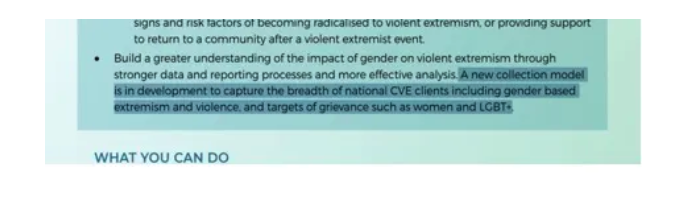
Public asked Home Affairs how it defines gender-based extremism, whether nonviolent online expression can trigger CVE referrals, and whether information collected by eSafety feeds into counter-extremism programs. The Department has yet to answer any of these questions.
Pre-Thought Crime
The Albanese government has backed the Australian Internet Observatory (AIO), which launched in 2024 through a national research infrastructure program that received A$25 million in federal funding. The Observatory is a consortium of six Australian universities developing tools to monitor and analyse Australians’ online activity.
One of the Observatory’s university branches is led by Matteo Vergani, director of Deakin University’s Tackling Hate Lab, which acknowledges support from the Department of Home Affairs. The Lab uses AI to study online radicalisation and political hostility, including whether patterns of online behaviour can provide early warnings of future violence.
In one Australian study, researchers analysed more than 86,000 online posts about protests involving transgender issues and claimed that hostility towards politicians sometimes increased before offline violence.
In another study, researchers created a computer simulation of an anti-immigration Facebook group to test methods of influencing users’ beliefs. They programmed virtual users to respond based on assumptions about human behaviour rather than using real participants. The researchers then used the results to recommend how authorities could intervene in online discussions as cost-effectively as possible.
Provisions in the DDoC will allow approved researchers to obtain previously private platform data and use covert “sock puppet” accounts to conduct their studies. If the Bill passes, these new powers will expand the Observatory’s work. Researchers involved in the AIO have actively supported the Bill, who as a government-favoured research institution stand to benefit greatly from the radically expanded access to user data the bill would provide them.
In Steven Spielberg’s 2002 science-fiction film Minority Report, a special police unit called “Precrime” relies on three psychics to arrest people before they have committed any crime.
As with a lot of science fiction, elements of this imagined future are beginning to take shape in reality. More than two decades later, Australia is developing the technological and institutional infrastructure for a version of the same idea. Instead of psychics, there are researchers developing models to supposedly predict violence, and government agencies micro-monitoring online behaviour for warning signs of future crimes.
In his recent speech urging Parliament to pass the DDoC, Prime Minister Anthony Albanese quoted Australia’s domestic intelligence chief, ASIO Director-General Mike Burgess. He relayed Burgess’s warning that social media was “exacerbating polarisation and creating a permissive environment for violence”, before returning to social-media algorithms, accusing them of promoting misogyny and cultivating a “frightening manosphere” that contributes to gender-based violence.
The way that both men draw a casual line between lawful online content and violence reflects a troubling trend in Australian politics, to stoke public panic that is then weaponized by the government and security agencies to justify radical censorship and surveillance programs that would have been unthinkable in calmer times.